
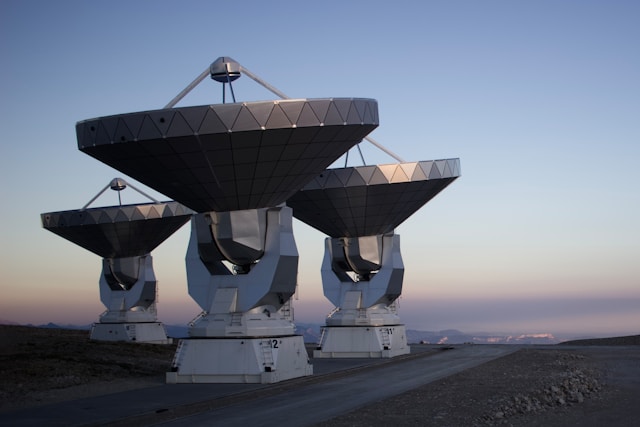
For sixty years the satellite industry’s defining object was the parabolic dish: a curved metal reflector that gathers radio energy from one direction and focuses it onto a feed, pointed by motors, doing one thing at a time. Almost every economic assumption of the classical industry descends from that object — that a ground station serves one satellite per antenna, that a satellite’s coverage map is fixed at launch, that consumer terminals must be aimed once and left alone, that adding capacity means adding steel.
The phased array dismantles every one of those assumptions. It is not a better dish; it is a different kind of thing, with different physics, different economics and — the part the industry is only now confronting — different regulatory consequences. Understanding it is no longer optional for anyone making decisions about satellite businesses.
What a phased array actually is
Take the reflector away and replace it with a flat panel carrying many small radiating elements — dozens, thousands, sometimes tens of thousands — spaced roughly half a wavelength apart. Feed the same signal to all of them and the waves add up in the direction perpendicular to the panel. Now delay the signal fed to each element by a precisely controlled amount, and the point where the waves reinforce each other moves: the beam steers, without anything moving. Reverse the process on receive and the panel listens in a chosen direction. That is the whole idea — beamforming by controlled interference, replacing geometry with computation.
Four consequences follow immediately from the construction. Aperture still rules: the panel’s total area sets its gain and the narrowness of its beam exactly as a dish’s diameter does, so physics grants no free lunch — a small array is a small antenna. Steering is electronic, accomplished in microseconds by changing phase settings rather than in seconds by driving motors. Each element can have its own amplifier — an “active” array, where transmit power is distributed across thousands of small chips rather than concentrated in one large amplifier. And if the phase control is done in software after digitising each element’s signal — digital beamforming — then the same aperture can form many independent beams at once, pointing in different directions, at different frequencies, for different users, simultaneously.
That last property is where the engineering becomes a business model.
The seven properties that change the economics
One aperture, many beams. A dish does one thing at a time. A digitally beamformed array serves many links from the same hardware, and the count is limited by processing and power rather than by mechanics. On a satellite this becomes hundreds of spot beams and aggressive frequency reuse; on the ground it means a single site tracking a dozen spacecraft at once — dissolving the “one antenna, one pass” arithmetic on which the entire ground-station-as-a-service market was built.
Instant handover. Low-orbit satellites cross the sky in minutes, and a constellation terminal must jump between them continuously. Mechanical trackers can do it, expensively and with wear; arrays do it between packets, which is why consumer LEO broadband was not commercially possible until flat-panel terminals were.
Flat form factor. A panel conforms to a car roof, an aircraft fuselage, a ship’s superstructure, a backpack. Whole mobility markets — aviation, maritime, land-mobile, and the new category regulators call earth stations in motion — exist because the antenna stopped being a bowl on a gimbal.
No moving parts. No motors, bearings or lubricants to fail. For unattended remote sites and for spacecraft, the reliability gain is worth real money.
Software-defined coverage. A satellite launched with a fixed beam plan sells the map it launched with; an array-equipped satellite reallocates capacity over its lifetime towards wherever demand has actually appeared. This converts a fifteen-year asset from a fixed product into a reprogrammable one, and it is the single largest change to satellite operators’ revenue models in a generation.
Nulls as well as beams. The same mathematics that steers energy towards a target can steer a null — a direction of deliberate deafness — at an interferer or jammer. Defence buyers pay for this directly, and, as we shall see, it is also a coordination instrument.
Semiconductor economics. The decisive one. A dish is metal fabrication: cost rises with size, quality depends on machining, and there is no volume learning curve worth the name. An array is electronics: cost falls with production volume, performance rides the semiconductor industry’s improvement curve, and the marginal unit approaches the cost of its chips. The satellite industry has spent its history buying antennas the way one buys bridges; phased arrays let it buy them the way one buys phones.
The limits vendors gloss over
Honesty about the constraints is what separates a useful assessment from a brochure.
Scan loss. Steer a beam away from perpendicular and the panel’s effective area shrinks with the cosine of the angle; performance degrades markedly beyond roughly sixty degrees off boresight. Full sky coverage therefore needs multiple panels or a tilted installation — a cost multiplier that headline specifications rarely mention.
Cost per unit of gain. For raw sensitivity at high frequencies, a large dish remains far cheaper than an equivalent array. Arrays win on flexibility, mobility and simultaneity, not on brute gain per pound.
Power and heat. Thousands of amplifiers consume power and produce heat proportionally. Terminal power draw and spacecraft thermal design are frequently the binding constraints, not the radio-frequency performance.
Bandwidth and beam squint. Simple phase shifters steer accurately at one frequency; across a wide instantaneous bandwidth the beam smears unless the design uses true time delay, which is dearer. Claimed bandwidth deserves scrutiny.
Frequency scaling. Element spacing is set by wavelength. At Ka-band the elements sit about four millimetres apart, which pushes tolerances, calibration and thermal stability towards the difficult end of manufacturing — the reason many array ventures perform impressively at S-band and struggle at Ka.
Calibration. Thousands of channels must be matched and kept matched over temperature and time. Calibration architecture is where array companies quietly differentiate, and it is the question least often asked of them.
| Parabolic dish | Phased array | |
|---|---|---|
| Steering | Mechanical, seconds, wear | Electronic, microseconds, no wear |
| Simultaneous links | One | Many (digital beamforming) |
| Cost driver | Size — metal fabrication | Volume — semiconductor production |
| Cost per unit gain | Low | High |
| Form factor | Bowl plus gimbal | Flat panel |
| Coverage flexibility | Fixed at build | Reprogrammable in software |
| Sky coverage | Full hemisphere | ~±60° per panel; scan loss beyond |
| Best at | High gain, fixed target, budget links | Mobility, multi-target, fast handover, interference control |
Where the money moves
User terminals were the first domino. Mass-produced flat panels made consumer LEO broadband a physical possibility and then, as volumes rose into the millions, an affordable one — the clearest demonstration in the industry’s history that antenna cost curves can create markets. Mobility followed: aviation and maritime connectivity are now array businesses, and the regulatory category of earth stations in motion exists because of them.
Satellites are mid-transition. Software-defined payloads with digitally beamformed antennas let operators sell capacity where demand materialises rather than where a beam plan guessed it would be — reshaping how fleets are financed, sold and refreshed. Direct-to-device pushes this hardest of all: to close a link to an unmodified phone, the satellite must present an enormous aperture with many independent beams, which is precisely a large space-deployed phased array.
The ground segment is the least noticed and most exposed. A phased-array ground station tracking many satellites simultaneously attacks the fundamental economics of a market built on scheduling scarce dish-hours: utilisation ceases to be a function of antenna count, handovers stop costing slew time, and a single site can serve a constellation rather than a pass. Ventures pursuing this have attracted defence contracts and substantial venture funding precisely because it threatens the incumbent teleport model rather than joining it.
Defence underwrites much of the above. Electronically steered arrays give jam resistance, nulling, rapid retasking and low-probability-of-intercept behaviour — capabilities procurement organisations pay for at prices commercial markets would not bear, which is how the technology’s development has largely been financed.
The regulatory collision nobody planned
Here is the part that belongs to this series, and that most technical treatments miss entirely: the world’s spectrum-sharing rules were calibrated against dish-era antennas, and phased arrays have quietly falsified their assumptions.
The sharing arithmetic that governs satellite coexistence — the power limits protecting geostationary networks from non-geostationary constellations, the coordination triggers, the interference thresholds — rests on reference antenna patterns, mathematical idealisations of how much energy an antenna spills in unwanted directions. Those references were derived when antennas were reflectors. Modern arrays, on both spacecraft and terminals, can achieve sharper discrimination, deeper sidelobe control and, crucially, dynamic behaviour: steering nulls towards protected arcs, switching beams to avoid in-line events, adapting patterns in real time. The technical core of the long-running argument that the 1990s power limits are overprotective is exactly this — that the rules price an interference risk the hardware no longer creates.
Three practical consequences follow, and they are live now.
Coordination gains new currency. In negotiations with counterparties, an array operator can offer commitments a dish operator never could: avoidance of specified geometries, nulling towards a neighbour’s arc, dynamic beam management during conjunctions. These are real, tradeable concessions — and they change what a coordination agreement can look like.
Filings strain against the form. The technical parameters an operator lodges with the ITU assume an antenna with a describable, fixed pattern. What does one file for an aperture whose pattern is software and changes by the millisecond? Administrations and operators are improvising, filing conservative envelopes that understate real-world behaviour, and the mismatch between filed characteristics and operational reality is becoming a genuine analytical problem for anyone assessing what a filing actually constrains.
The rules are fragmenting around the technology. Because the treaty process moves slowly and the hardware does not, national regulators have begun rewriting sharing rules domestically to reflect modern antenna performance — with the consequence, discussed elsewhere in this series, that identical international rights now carry different operational value in different jurisdictions. Phased arrays did not cause that fragmentation, but they supplied its technical justification.
Hands-on: choosing, and testing the claims
For an operator deciding between architectures, the choice resolves cleanly. Choose an array when you must track multiple or fast-moving targets, when the terminal must move or be flush-mounted, when handovers are frequent, when the site is unattended or hostile, or when interference rejection is a requirement. Choose a dish when you need maximum gain per pound on a fixed link, when the budget is tight, and when nothing is moving. Many mature designs use both — arrays for agility, reflectors for the heavy links.
For an investor or buyer assessing an array claim, six questions separate substance from marketing. What are the gain-to-noise and radiated power figures at maximum scan angle, not merely at boresight? How many simultaneous beams, and are they genuinely independent in frequency and direction? What is the instantaneous bandwidth, and is true time delay employed? What is the power draw and thermal solution at full duty? How is calibration performed and maintained over temperature and life? And what is the projected unit cost at realistic production volume — since the entire economic case rests on the volume curve rather than on the prototype. A vendor comfortable with all six is a serious one; a vendor who answers only the first is selling a boresight number.
The larger point is worth holding onto. The dish shaped an industry of fixed positions, scarce antenna-hours, coverage maps frozen at launch and rules written around a metal parabola. The phased array replaces each of those with something programmable — and programmable assets behave differently in markets, in balance sheets and, as the current regulatory fights demonstrate, in law. An antenna is rarely a strategic subject. This one is.